Your Cart is Empty


PTSD Complex Trauma Master Class # 24-25 Sept 2026 # LIVE, Online, Interactive Workshop #
£259.00
Live Online Interactive Clinical Skills Training with Actor-Based Simulation
Breaking the Traumatic Memory-Threat Cycle: 13-Hour CPD
ThePTSD & Complex PTSD Masterclass is designed for clinicians who already understand the fundamentals of PTSD and want to become more confident in the clinical decisions that matter when treatment becomes less straightforward.
The focus is practical: how to assess what is maintaining the problem, decide what to prioritise, and intervene effectively when traumatic memories are experienced not only as images and conventional flashbacks, but through bodily sensations, agitation, anger, urgency, shutdown or dissociative states.
The workshop provides a structured, evidence-based approach drawing primarily onTrauma-Focused CBT, alongside relational and somatically informed clinical practice. Core components includeEnhanced Reliving and trauma-memory updating, Trigger Discrimination, and Reclaiming Your Life, with particular attention to when and how these interventions are used, common treatment pitfalls, and the moment-to-moment decisions that experienced trauma work requires.
A central part of the Masterclass is learning throughlive actor-based clinical work. Rather than only hearing how trauma therapy should work, you will see realistic therapy interactions unfold, examine the decisions being made and consider how you would respond yourself.
Day 1: 9:30-16:00
Understanding and Disrupting the Traumatic Memory-Threat Cycle
We begin with the clinical science underlying PTSD and translate it directly into formulation and treatment.
- How traumatic memory processes contribute to the maintenance of PTSD
- Using contemporary neuroscience in ways that are clinically useful rather than simply descriptive
- Understanding the Ehlers & Clark model through real clinical presentations
- Helping clients process traumatic memories while managing distress and maintaining therapeutic safety
- Enhanced Reliving and trauma-memory updating within a relational Trauma-Focused CBT approach
- Recognising when flashbacks are primarily visual, sensory, somatic or affective
- Trigger Discrimination for flashbacks and intrusive sensory or somatic memories
- Common pitfalls in trauma-focused therapy and how to avoid them
- Recent developments in trauma research and what they actually change in practice
- Keeping formulation sufficiently simple to guide treatment without losing important complexity
Day 2: 9:30 - 16:00
From Knowing the Model to Doing the Therapy
Day Two brings the clinical work into the room.
Using a professional actor portraying a highly credible therapy client, we will observe Trauma-Focused CBT as it unfolds and examine the decisions that arise moment by moment.
When do you stay with the traumatic memory? When do you slow down? What does a shift in the client's state tell you? Is this avoidance, dissociation, threat activation or something else? What should happen next?
We stop, discuss, formulate and return to the work. This allows participants to see not onlywhat an intervention looks like, but the clinical reasoning behindwhen, why and how it is used.
We will work with:
- Enhanced Reliving, trauma-memory updating and common missteps
- Trigger Discrimination for flashbacks and intrusive sensory or somatic memories
- Recognising and responding to dissociative states
- Building tolerance of threat-related internal experiences
- Reclaiming Your Life following trauma
- Difficult clinical decisions and therapy stuck points
- Additional case material illustrating different PTSD and Complex PTSD presentations
Small-group, clinically focused learning
Our small-group workshops are designed to besafe, highly interactive clinical learning spaces where you can ask the questions that arise in your own work, test your thinking and have direct access to specialist clinical consultation.
You will observe therapy as it unfolds, work with realistic clinical material and explore the decisions that sit underneath effective trauma therapy. The emphasis throughout is practical and action-oriented: not simply understanding what good trauma work looks like, but developing the confidence and clinical judgement to do it yourself.
The approach isstrongly relational and non-pathologising. We are interested in understanding what has happened to people, how their responses make sense in context, and how to work with those responses without losing clinical precision.
My aim is that you leave not just more knowledgeable, butmore skilled, more confident and more able to handle the complexity of real trauma work.
|
British Psychological Society Approved Workshop for Purposes of CPD
|
12 Hours CPD Certificate
|

Presenter
- ◄Presenter Dr Heather Sequeira PhD
-
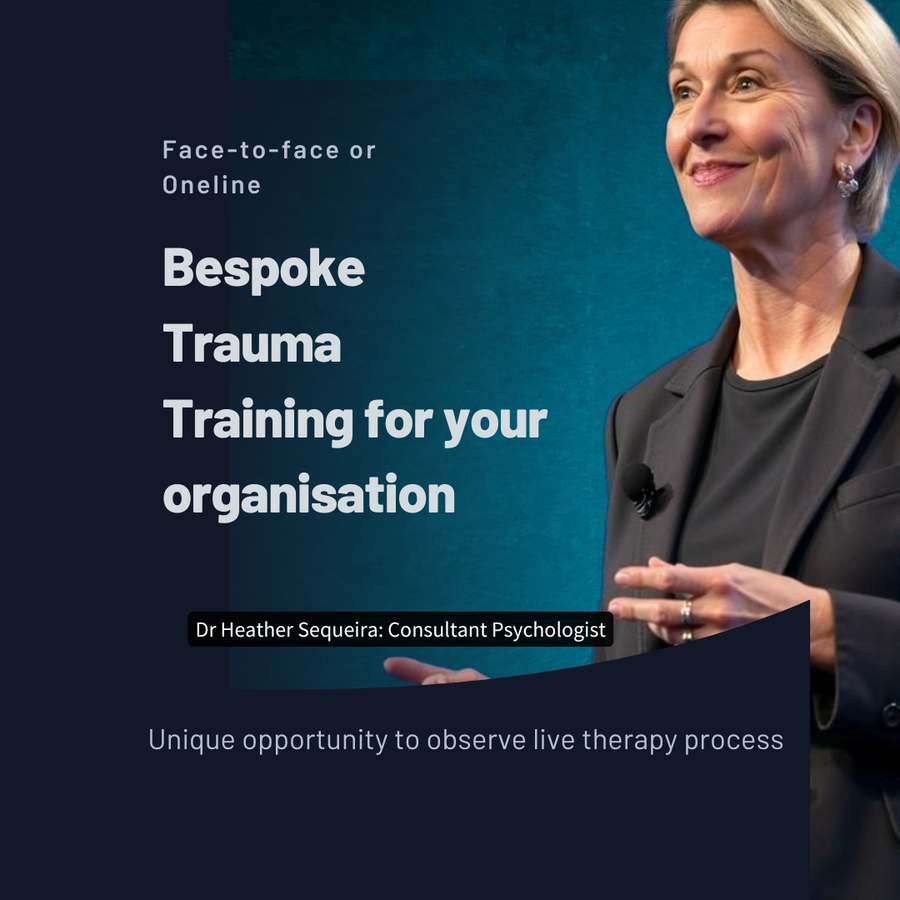
Dr Heather Sequeira PhD has a solid background in Trauma related research and worked as Senior Research Fellow, University of London prior to training as a clinician. Heather is now an executive committee member of the British Psychological Society Crisis, Disaster & Trauma BPS Section. She has input to British Psychological Society CPD, Clinical Psychology Doctoral Training programmes and CBT Diploma Courses. She has 20 years NHS experience, plus private practice and organisational context work. She has a particular specialty in Complex PTSD & Trauma-related OCD.
The unique style of PTSD Trauma Workshop was born not only out of the above expertise but from supervising other psychologists, trainees and therapists. These clinicians were often highly trained and experienced, but what they said they lacked was the opportunity to observe other clinicians at work. They said that what they really wanted was to ‘look over the shoulder’ to observe another clinicians to help build both skills and confidence. Often supervises were struggling with similar therapeutic issues, despite being at different stages of the professional journey and they wanted to push the boundaries of their own learning within a safe, non-judgmental space.
The workshops are a unique response to the above needs: The workshops focus on "real-life" clinical issues, clients who are "stuck" or who have complex needs. They are highly practical, with clinical observation using the live actor "therapy simulation" and video footage for skills work. We offer a stop & pause format so that delegates can stop, discuss, and pull open the clinical decision-making steps at each stage of the therapy process. The process brings life-like and safer skills practice into the workshop. This process offers unique hands-on training for professionals with sound theory to practice transfer.
Heather's expert knowledge of clinical practice, extensive research experience and excellent training skills make her the most stimulating trainer to work with.
- ◄Live therapy demonstration & skills practice
-
This is a highly practical training with ample opportunity to see live demonstration of Trauma-Focused therapy. We use a professional actor as our client. This helps us to to map out the therapy interaction in the most realistic way possible, whilst effectively integrating theory with practice. We try not to shy away from real work complexities, therapy pitfalls & tough decisions. This is a fantastic opportunity to look inside the therapy process, with an extensive debrief into both the decision making & intervention processes.
Interaction and small group discussion is encouraged but no pressure is placed on people who prefer to sit back and take it all in.
- ◄Continuing Professional Development (CPD Hours) Certificate of Attendance:
-
You will receive a Certificate of Attendance for hours of CPD at your workshop.
- 6 Hours for a 1 day workshop
- 12 Hours for a 2 day workshop
- 18 Hours for a 3 day workshop
Please check that you have told us the correct name to be printed on your certificate, especially if you are from an organisation and booking a workshop for someone else.
- ◄Levels of Competence
-
Delegates are required to be qualified mental health practitioners (i.e. have registration with a Regulatory Body such as HPCP or accreditation with a relevant professional body) OR to be in training / in the process of gaining such accreditation. A CPD workshop does not qualify you to practice psychological therapy. For this you need a appropriate professional qualification and validation by an appropriate regulatory body. Delegates are required to have appropriate psychological supervision for their practice.
There may be occasional exceptions in attendance to the above requirement (for example, a trauma researcher or similar who is not practicing with clients but requires insight and infomation for research purposes). Any exception to the above requirement has to be agreed with us in advance. Please do get in touch to discuss.
Level of Competence Required:
Before booking a place on a workshop, please ensure that it is pitched at the appropriate level of competence for you. The competence level [Preliminary, Intermediate, Advanceded] of each workshop is listed on each booking page. The 3 different workshop levels are as follows:
Preliminary Level Workshops
Preliminary workshops are for people from a variety of psychological therapy backgrounds who are looking for grounding in the basic concepts or a recap. These courses ideal for professionals who want to develop & their practice skills to help clients with a history of trauma. It is also an excellent recap for advanced level practitioners. Whether clinicians are counsellors getting their first exposure to CBT for trauma or seasoned practitioners wanting a refresher, this will satisfy professional training needs. For Preliminary workshops, NO prior CBT experience is necessary.
Intermediate Level Workshops
Intermediate level workshops are directed to trained mental health practitioners who are familiar with and able to use the fundamental principles of CBT and Relational Approaches. For example, practitioners are able to use formulation, identify automatic thoughts and able to help clients test these thoughts. To use the enhanced reliving components with your clients, practitioners should have skills in CBT and be supervised by practitioner who uses reliving as part of their own clinical practice and is competent to do so.
Advanced Level Workshops
Advanced courses are directed towards those professionals who already have additional training in PTSD and Trauma and use CBT and other Relational Approaches routinely as part of their clinical practice. They have probably undertaken a significant number of training courses and/or workshops, and use a broad range of strategies to work with a range of presentations at varying levels of complexity.
These workshops are defined as Continuing Professional Development. As such they are designed for people with a recognised UK psychological therapy qualification or for those in training for such qualification. Although highly informative, none of workshops confer a formal qualification or assurance of competence in any aspect of psychological therapy since we are unable to assess attendee competency within the training event.
- ◄Confidentiality
-
Workshops contain clinical material. This is always anonymised as far as possible but delegates are none the less reminded to respect confidentiality and to anonymise any clinical material that they bring to the workshops.
Just as in therapy sessions, workshop sessions will be treated as confidential, with the following exceptions. As a Chartered and Registered Psychologist I am required to seek supervision by my professional body (The British Psychological Society) and regulatory body (HPCP) as a means of ensuring good practice. We do have a statutory obligation to break confidentiality under rare circumstances, namely, if I believe that a person is of danger to themselves or to others (under the Mental Health Act, 2001) or if I believe that a child is at actual risk of physical or sexual abuse (The Children Act, Section 47, 1989)
- ◄Self-Care & Special Needs
-
Our own professional responsibility for good self-care is emphasised throughout the trainings. All the Workshops contain detailed discussion of clinical case material and simulated client work. This includes (but is not limited to) sexual assault, sexual abuse, interpersonal violence, accidents, RTAs, war and other types of trauma. If you are in doubt as to whether this CPD workshop is appropriate for you, please discuss with us in confidence.
We welcome people from diverse backgrounds. If you have any particular needs, please contact us prior to booking.